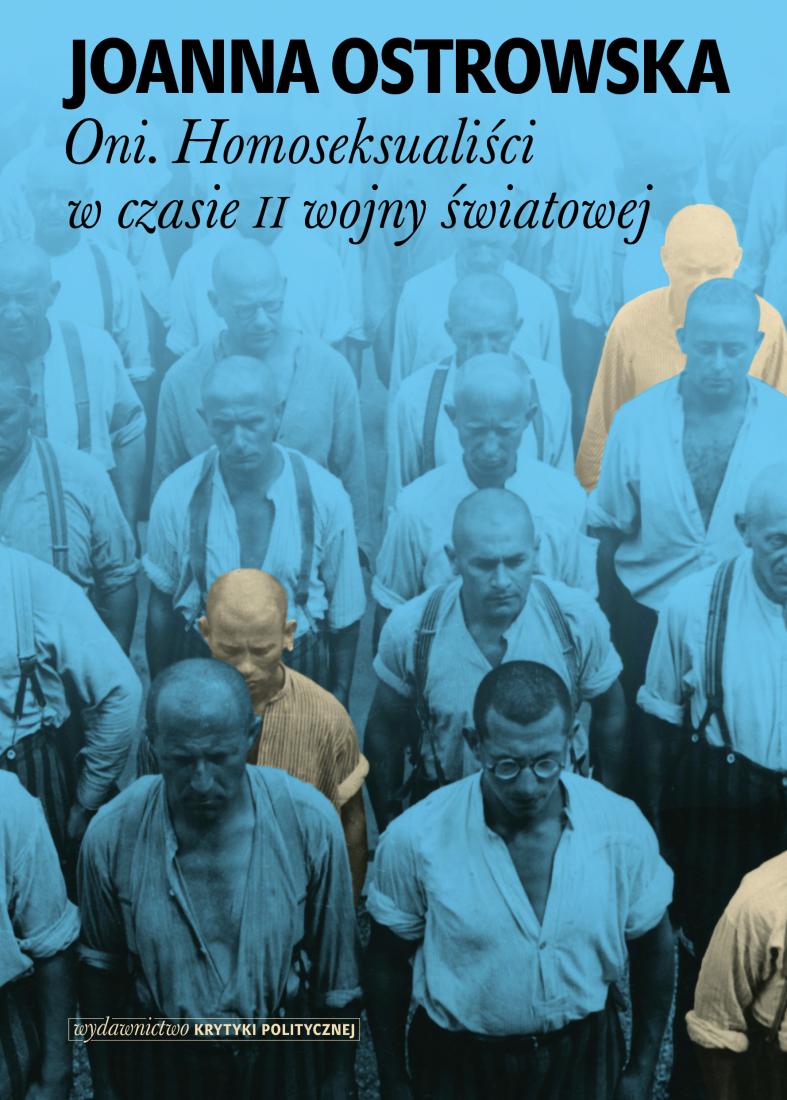
They: Homosexuals During World War II The Audience Award of Nike Literary Award 2022.
The few Germans who sexually abused and tormented other prisoners in Nazi penitentiary establishments - this was how men sentenced in 1933–1945 in Poland were defined under section 175 stigmatizing homosexual relations.
"They" were strangers; they were predators and there were very few of them. For these three reasons, their history was not dealt with, commemorated and treated as victims of the Nazi system. The survivors were kept silent. There was supposed to be no "such" people in Poland.
Homosexual men were arrested and imprisoned in Rawicz, Międzychód, Wronki, Strzelce Opolskie or Tarnów. They were taken to KL Sachsenhausen, KL Buchenwald, KL Mauthausen, KL Gross-Rosen, the Auschwitz-Birkenau-Monowitz camp complex and Majdanek. They died in penitentiary units in the territory of the Reich, and if they managed to survive, they returned home. Their graves can be found in Polish cemeteries. The story of them does not consist of individual traces. Even if their biographies are incomplete, often broken or lacking a finale, they create an extensive polyphony.
The history of non-heteronormative people during World War II is still taboo. Seventy-five years after the end of the war, there are practically no publications on them in Poland, it is difficult to find even small fragments in general studies.
"They" don't exist because of our fault. Blurred by pre-war phantasms fueled by Nazi propaganda and perverse war and camp rumors, they were equated with nameless seducers, criminals, an anti-social element. Finally, one has to rebel against these ideas, and it is impossible to remain silent about "them".
„Oni” byli obcy; byli drapieżcami i było ich bardzo niewielu. Z tych trzech powodów nie zajmowano się ich historią, nie upamiętniano i nie traktowano jako ofiar nazistowskiego systemu. Ocaleńców przemilczano. W Polsce „takich” ludzi miało nie być.
Homoseksualnych mężczyzn aresztowano i więziono w Rawiczu, Międzychodzie, Wronkach, Strzelcach Opolskich, czy Tarnowie. Wywożono do KL Sachsenhausen, KL Buchenwald, KL Mauthausen, KL Gross-Rosen, kompleksu obozowego Auschwitz-Birkenau-Monowitz oraz na Majdanek. Ginęli w jednostkach penitencjarnych na terenie Rzeszy a jeśli udało im się przeżyć, wracali do domu. Ich groby można odnaleźć na polskich cmentarzach. Opowieść o nich nie składa się wcale z pojedynczych śladów. Nawet jeśli ich biografie są niepełne, często urwane lub pozbawione finału, to tworzą rozbudowany wielogłos.
Historia osób nieheteronormatywnych w czasie II wojny światowej nadal pozostaje w sferze tabu. Siedemdziesiąt pięć lat po zakończeniu wojny nie ma w Polsce praktycznie żadnych publikacji na ich temat, trudno o nawet drobne fragmenty w ogólnych opracowaniach.
„Oni” nie istnieją z naszej winy. Zamazani przez przedwojenne fantazmaty podsycane nazistowską propagandą i perwersyjne plotki wojenne i obozowe, zrównani zostali z bezimiennymi uwodzicielami, kryminalistami, aspołecznym elementem. Przeciwko tym wyobrażeniom trzeba się wreszcie zbuntować, a o „nich” nie da się już dłużej milczeć.



 Wish listBuy now
Warszawa : prawoslawie i rosyjskie dziedzictwo
Wish listBuy now
Warszawa : prawoslawie i rosyjskie dziedzictwo Wish listBuy now
Slawni pacjenci w gastroenterologii
Wish listBuy now
Slawni pacjenci w gastroenterologii Wish listBuy now
Kronika zamkowa : roczniki = The castle chronicles : annuals
Wish listBuy now
Kronika zamkowa : roczniki = The castle chronicles : annuals

