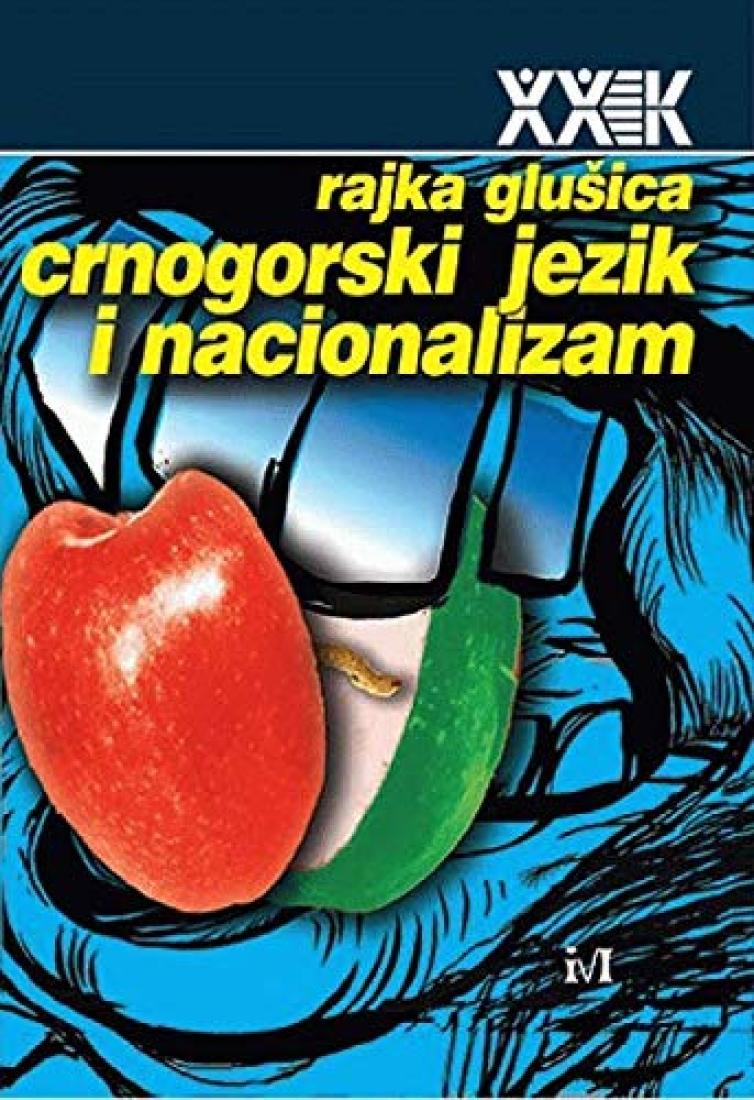
Montenegrin Language and Nationalism At the Faculty of Philosophy in Nikšić, Vojislav fought for the Montenegrin language and literature for decades. He perceived every, even the smallest gesture of benevolence of his colleagues as support for his views. In his idealism, he often failed to distinguish sincere solidarity from the pretentious, careerist ambitions of individuals. Only a year after the mentioned controversy in the Monitor, Vojislav euphorically told me in one conversation: "Rajka is Montenegrin!" Knowing him as a good-natured person, inclined to easily and too quickly believe in the good intentions of the people around him, I reminded him of the controversy and attitudes. Glušica represented her in it, but Vojislav answered me only briefly: "Let it go now, she is a Montenegrin, she just must not be exposed."
On Sunday around the referendum in Montenegro, Glušica announced for the first time that the Montenegrin language was acceptable to her, and Vojislav used all his respectable connections with experts in Slavic studies to promote another Montenegrin philologist internationally who, for a start, at least it no longer denies the existence of the Montenegrin language. Vojislav soon contacted me to use my authority in the Republic of Croatia to help form a commission for the election of Rajko Glušica to the title of full professor. The public was told that her election was allegedly blocked due to her advocacy for the Montenegrin language, which was at least an unusual explanation, since the commission that rejected her election, along with her mentor Ostojic, whose supporter she had been for decades, included also Živojin Stanojčić, a prominent Serbian linguist who always consistently fought against Serbian hegemonic linguistic policy, as well as Ljiljana Subotić, who looked at Vojislavl's work with great sympathy. No one could convince me that Stanojčić and Subotić, whom I knew as honorable people and excellent experts, prevented the election of Rajka Glušica for political reasons, but I could not refuse Vojislav's request, so I tried to comply with my competencies and I can ask for possible members of the new commission for election to the title.
Shortly afterwards, immediately after Vojislav's death, I had the opportunity to host Rajko Glušica in Osijek. After being prevented from completing his postgraduate studies in Nikšić, Adnan Čirgić, whom Vojislav considered the most talented Montenegrin philologist in recent years, enrolled in a doctoral program in linguistics at the Faculty of Philosophy in Osijek, where he defended an excellent dissertation on the speech of Podgorica Muslims. In the process of forming the dissertation defense commission, when the then president of the Croatian Academy of Sciences and Arts, Milan Moguš, was appointed its president, I was asked by the home faculty to propose one of the Montenegrin linguists to be a member of the commission. changed retrograde linguistic views, and in order to help its affirmation outside the borders of Montenegro, proposed that it be Rajko Glušica. Glušica did not hide that she was particularly impressed by such an offer, so she gladly responded. The defense itself was at an extremely high level, and it was attended by some of the most prominent Croatian linguists, such as the onomastician academician Petar Šimunović, who arrived from Split just for the occasion.



 Wish listBuy now
Govorite li zajednicki? : kako je nastala i kako je primljena Deklaracija o zaj...
Wish listBuy now
Govorite li zajednicki? : kako je nastala i kako je primljena Deklaracija o zaj... Wish listBuy now
Belorusija i Srbija : tragom uzajamnog upoznavanja i delovanja
Wish listBuy now
Belorusija i Srbija : tragom uzajamnog upoznavanja i delovanja Wish listBuy now
Recnik backih Bunjevaca : iliti Ricnik backi Bunjevaca
Wish listBuy now
Recnik backih Bunjevaca : iliti Ricnik backi Bunjevaca